
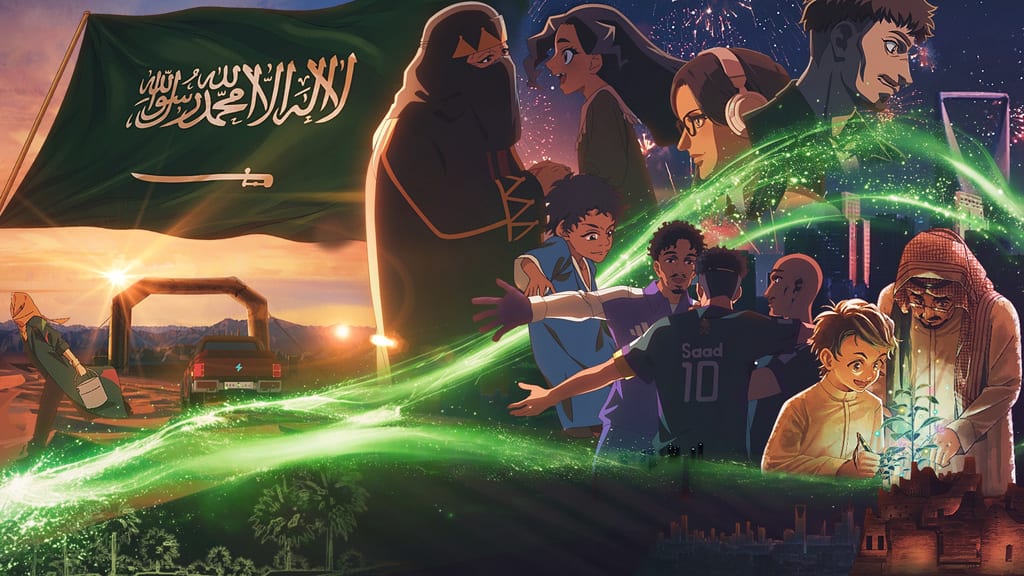
On November 2, as part of the TOKYO ANIME NEXT event at Toshima Civic Center in Tokyo, a special seminar titled “Two Cultures, One Story — Behind the Scenes of a Japan–Saudi Co-Production” brought together key figures from both countries to discuss the making of a short anime that became a global phenomenon.
How Two Companies Found Each Other Across Borders
Nour Al-Jisakli, Supervising Producer at Saudi Arabia’s Manga Productions, and Kimura Makoto, Representative Director and Producer at Japanese entertainment company BLUE RIGHTS, took the stage to share the story behind the short animated film “Saudi National Day 96” and to explore the broader possibilities of cross-cultural creative collaboration.
Manga Productions was founded in Riyadh in 2011 and opened a Tokyo office in 2017. The company focuses on manga and anime content production, with a strong emphasis on partnerships with Japanese studios and on bringing Japanese anime to international audiences. In Saudi Arabia, it is customary for companies to produce commemorative videos for National Day each year, and Manga Productions has been creating short anime for the occasion since 2021.
“Saudi National Day 96” uses a green pen — the color of the Saudi national flag — as its central motif, depicting people from all walks of life picking up a pen and pursuing their dreams. The film has racked up 23.8 million views on YouTube alone, and when combined with TikTok, Instagram, and other social media platforms, the total surpasses 100 million views.
Kimura Makoto brings extensive industry experience, having worked on Fuji TV’s “Noitamina” programming block as well as at Twin Engine and MAPPA. Nour explained that BLUE RIGHTS was chosen as a partner because Kimura was “very open-minded, deeply understood Saudi culture and its spirit, and had a strong commitment to quality.”
An On-Location Scout in Saudi Arabia — Unprecedented for a Short Anime
Production began with a concept and original plan prepared by Manga Productions, which was then developed further by the Japanese creative team. Nakamura Ryosuke directed the film, with Hosoi Mieko handling character design.
One of the most remarkable aspects of the production was an on-location scouting trip to Saudi Arabia — an extremely rare step for a short-form anime. At Kimura’s suggestion, key staff including the director traveled to Saudi Arabia in person. The trip yielded discoveries impossible to find from a desk in Japan: that parts of Saudi Arabia actually receive snowfall, for instance, and that because daytime temperatures are so high, people commonly hold picnics in parks at night.
These firsthand experiences translated directly into the film’s authenticity. The unique way a female character holds her hands to her chest, the precise manner in which a hijab is wrapped, and the subtle gestures and expressions of the characters all reflect the atmosphere the team absorbed on the ground. Nour was emphatic: “The location scout was absolutely the right call. The texture and feel of Saudi culture comes through clearly on screen.”
Bridging the Cultural Gap — Discipline Meets Passion
The seminar also delved into the cultural and expressive challenges of anime production. Japanese animation has developed sophisticated techniques for stylizing characters symbolically, but deciding which cultural details — clothing, gestures, religious practices — to simplify and which to preserve accurately required careful supervision and ongoing dialogue with the Saudi side.
Kimura reflected: “The desire to make something great is universal among creators, regardless of nationality. The Saudi creators in particular struck me as deeply sincere about the work. My role was to ‘translate’ the language and methodology of anime production for them, since there were nuances they weren’t yet familiar with.” Nour, for her part, noted that anime production demands genuine passion to sustain, and praised the high level of discipline and order she observed in Japan. She argued that it is precisely the fusion of “order and passion” that enables great work to emerge consistently.
A Young Nation, a Booming Market — and a Vision for the Next Decade
The seminar closed with a look at the future of anime in Saudi Arabia. Approximately 70 percent of the country’s population is under 35, and a large proportion of that demographic has grown up watching anime — making Saudi Arabia one of the fastest-growing and most enthusiastic anime markets in the world.
Nour set out her vision for the next ten years: “I want to continue co-producing with Japan while also nurturing the technology and the creators within Saudi Arabia itself, until we can produce work that rivals Japan in quality.” Kimura echoed the sentiment, noting that the anime industry’s production models have changed dramatically in recent years — citing fully self-funded production schemes as one example — and framing the Saudi collaboration as part of that new era. “I want to keep bringing fresh winds into the Japanese anime industry,” he said, bringing the seminar to a close.
 (แชร์แล้วไปกดรับที่หน้าภารกิจ · วันละ 1 times)
