
Summer 2026 has arrived in full force — fireworks festivals, big events, family trips — and the world feels like one long celebration. But even in the middle of all that energy, it’s easy to feel quietly left behind. Three anime this season have a way of meeting you exactly where you are, without fanfare or fuss.
Note: This article discusses plot details from each series. Spoiler-sensitive readers, proceed with care.
Remembering What You Love: Kore Kaite Shine (これ描いて死ね)
The title — roughly “Draw This and Die” — sounds alarming, but Kore Kaite Shine, airing on Nippon TV’s “Fura Ani” block, is a warm, funny, and genuinely moving coming-of-age story about high school girls who pour everything into making manga.
Set on the fictional “Izu Ojima” island (modeled on the real Izu Oshima), the show fills its frames with blue skies, lush greenery, and glittering ocean — visuals that loosen something in your chest just by watching. The opening theme, “Isho” by Kitani Tatsuya, adds to the effect; steel pan notes scattered through the track make it feel like a short escape from city life.
The standout moment of episode one comes when protagonist Ankai Ai finally meets “☆野0,” the manga artist behind Robota to Pokota — the series that changed her life — only to discover it’s her terrifyingly strict teacher, Teshima. Through tears, Ai tells him she’s been waiting for his next work all this time. It’s the kind of scene that catches you off guard and pulls tears out of you before you realize what’s happening.
Ai goes on to found a manga research club, but the series is careful not to be a simple success story. Teshima once chased the same dream and failed, and that history shapes how he mentors his students — not with empty encouragement, but with honesty about how hard the road really is.
The show holds both things at once: the dazzling spark of a dream being born, and the quiet ache of a dream that didn’t make it. For anyone who’s gotten so buried in work and routine that they’ve forgotten what they used to love, Kore Kaite Shine offers a gentle push forward.
Company for Exhausted Nights: Super no Ura de Yani Suu Futari (スーパーの裏でヤニ吸うふたり)
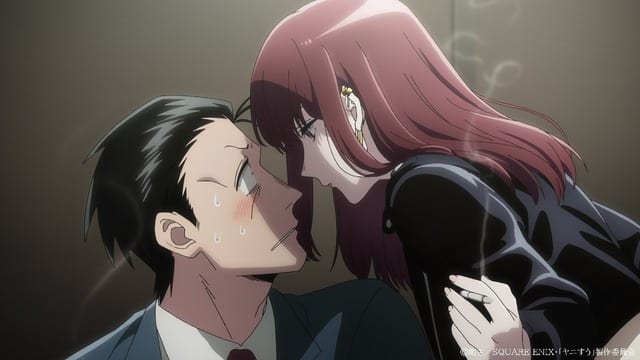
For the days when everything goes wrong and you crawl home wondering how you’ll get through tomorrow, Super no Ura de Yani Suu Futari (Two People Smoking Behind the Supermarket) is the show to reach for.
The key visual suggested something darker — a gritty adult drama, maybe. The reality is far gentler: a series built almost entirely around quiet nighttime conversations, perfectly suited to late-night viewing.
Middle-aged salaryman Sasaki gets yelled at by an unreasonable boss every day, struggles to connect with new colleagues, and regularly works past midnight. His one small pleasure is seeing the smile of supermarket cashier Yamada on his way home. That sounds odd on paper, but Sasaki is so genuinely pure-hearted about it — he just wants to see that smile, nothing more — that he becomes immediately endearing.
Yamada, who teases Sasaki by pretending to be a coworker named Tayama, has her own rough edges. She keeps her cheerful face on through every shift, but unreasonable customer complaints wear her down too. When she admits as much, Sasaki doesn’t offer advice or hollow reassurance. Instead he says: “It’s sad, isn’t it — the moment you see a different side of someone, you can’t trust the person you admired anymore… even though both sides are the same person.” That kind of response — not fixing, just witnessing — lands differently than any pep talk.
The show is more than a slow-burn romance between an earnest older man and a playful younger woman. It’s about people who work hard and still feel like they’re coming up short, and the small comfort of having someone simply acknowledge that. Watch it on a bad night, and you’ll likely finish it feeling like you can take things one step at a time.
The Happiness That Doesn’t Need Explaining: Seihantai na Kimi to Boku Season 2 (正反対な君と僕)
Seihantai na Kimi to Boku (You and I Are Complete Opposites) Season 2 began airing on July 5, 2026, picking up directly from the Winter 2026 first season.
The pop-art character designs are immediately charming, the comedy lands at a pace that makes you laugh out loud, and the romantic moments deliver exactly the warmth you’d expect from a school romcom. But if that were all it had, it wouldn’t be this easy to get absorbed in.
The characters appear to have ideal high school lives — good friends, budding romances, easy social circles. What the series does quietly and carefully is show the underside of all that brightness. Each character carries small, hard-to-name anxieties about fitting in and being understood — the kind of worries that feel too minor to bring up but never quite go away.
Taira, scarred by middle school experiences, second-guesses everyone’s motives and puts the brakes on his own happiness even when he doesn’t want to. Protagonist Suzuki, the most outwardly vibrant character in the cast, can’t stop worrying about how others see her; in Season 2, her attempts to impress boyfriend Tani‘s family spiral into painfully relatable overcompensation.
Watching them, you keep thinking “I know exactly how that feels” — and that recognition turns passive viewing into genuine investment. You’re not just entertained; you’re rooting for them.
Beyond the laughs and the romance, Seihantai na Kimi to Boku quietly tells you that the things you find hard to put into words are felt by other people too. Even if you usually skip romcoms, give this one an episode. It has a way of leaving you with the feeling that being exactly who you are is enough.
 (แชร์แล้วไปกดรับที่หน้าภารกิจ · วันละ 1 回)
