
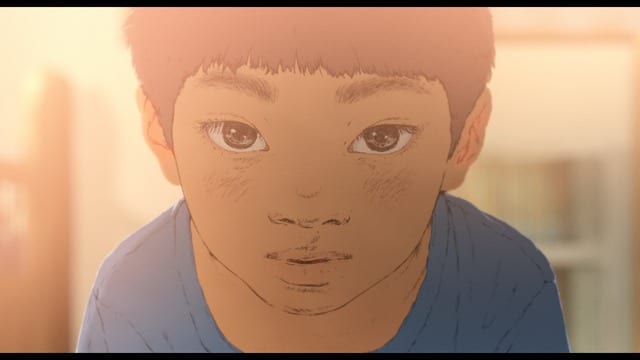
Debut feature film We are Aliens (我々は宇宙人), directed by Kadowaki Kohei, is set to open across Japanese theatres on 25 September. The film has already made waves internationally, earning a spot in the Directors’ Fortnight at the 79th Cannes International Film Festival and selection for the Feature Film Competition at Annecy International Animation Film Festival 2026 — a remarkable achievement for a first-time feature director with no prior TV anime credits.
Story and Origins
Set in a rural Japanese town during the Heisei era, the film follows the 30-year friendship between Tsubasa, a shy boy troubled by his own ordinariness, and Akitaro, the popular, seemingly “special” kid in class. The story is a coming-of-age nostalgia anime that traces their bond from childhood into adulthood.
Kadowaki says the seed of the idea was planted when he was in his early twenties — a vague desire to preserve his own childhood memories through animation. The story had no concrete shape until four years ago, when he met producer Hayashi and committed to making a feature film. He built the screenplay outward from a major mid-story turning point, carefully structuring the emotional arc of each chapter.
Engineering the Audience’s Emotional Ride
The director says the central challenge he identified early in production was sustaining audience engagement for a full two hours. His solution was to obsess over the rhythm of emotions rather than simply stringing together impressive visuals. He compares the ideal film structure to a roller coaster — not one that goes fast the whole time, but one that knows when to pause at the top before the plunge. He cites the moment in Spirited Away where Chihiro nervously descends the stairs and suddenly slips as a perfect example of this kind of emotional acceleration.
Around 20–30% of the film’s episodes draw from his own real experiences, including a first-love storyline. The rest was crafted to plant what he calls “nostalgia triggers” — tiny, specific details like the way a school bag breaks or how a classroom desk chips at the corners — so that each viewer finds their own personal memory unlocked somewhere in the film.
Visual Style and Wearing Many Hats
The film is visually distinctive for its high information density and realism. Kadowaki explains that the style emerged directly from what the story required: to make audiences feel genuine nostalgia, every background, prop, and character needed to be packed with authentic detail.
To maintain a unified visual tone, Kadowaki took on an unusually wide range of roles himself — Animation Director, Art Director, editor, color designer, and he personally handled color grading on every single cut. He also instructed background artists to use the same brushes as the character animators, ensuring the two layers would feel visually cohesive rather than mismatched.
Lens Thinking and Rotoscope
One aspect of the film that drew specific praise at Cannes was its layout work, which reflects a sophisticated understanding of real camera lenses — switching between telephoto and wide-angle perspectives according to dramatic intent. Kadowaki admits this was entirely intuitive; since roughly 80% of the films he watches are live-action, he had absorbed the language of lenses naturally over the years.
The film also employs rotoscope selectively. Live-action reference footage was shot for nearly every cut, with child actors recruited through auditions for the childhood scenes. Kadowaki himself stepped in front of the camera when time was short. Rather than tracing the footage directly, he used it as a foundation and adjusted the animation on top — preserving the spontaneous, slightly chaotic movement unique to real children, while layering on more stylised animation for hair and clothing to achieve a hybrid of live-action naturalism and anime expressiveness.
Influences: Doraemon, NARUTO, and 1980s Blockbusters
When asked about his influences, Kadowaki is refreshingly mainstream in his answer. He cites the Doraemon theatrical films, Studio Ghibli, and the manga NARUTO as formative works, alongside 1980s films like The Terminator and Back to the Future — introduced to him by his father — as well as Jackie Chan and Bruce Lee. In painting, he was drawn to Impressionism and 17th-century Realism from a young age.
As a contemporary filmgoer, he follows widely acclaimed titles as they emerge — Parasite from Korea, or the films of Koreeda Hirokazu in Japan. He says he deliberately aimed to make We are Aliens accessible and easy to follow, noting that most films he himself finds impenetrable are ones he simply cannot follow either.
His parting message to audiences: the film is filled with hidden nostalgic items and references that the staff worked hard to license. He encourages viewers to compare notes with friends after the screening on how many they managed to spot — and promises that repeat viewings will always reveal something new.
Film Details
- Title: 我々は宇宙人 / We are Aliens
- Release Date: Friday, 25 September — nationwide in Japan
- Distributor: TOHO NEXT · NOTHING NEW
- Director / Screenplay / Planning: Kadowaki Kohei
- Cast: Bando Ryuta, Okayama Amane, Yamazaki Ten (Sakurazaka46), Matsui Kemuri, Makiki Yuto, Nakagomi Yuku, Suzuki Saki, Suenaga Haru
- Music: Yaffle
- Theme Song: adieu — “ささくれ” (Sasakure); words & music by Yaffle (Sony Music Labels)
- Production: NOTHING NEW / MIYU PRODUCTIONS
© NOTHING NEW, MIYU PRODUCTIONS
 (แชร์แล้วไปกดรับที่หน้าภารกิจ · วันละ 1 回)
