
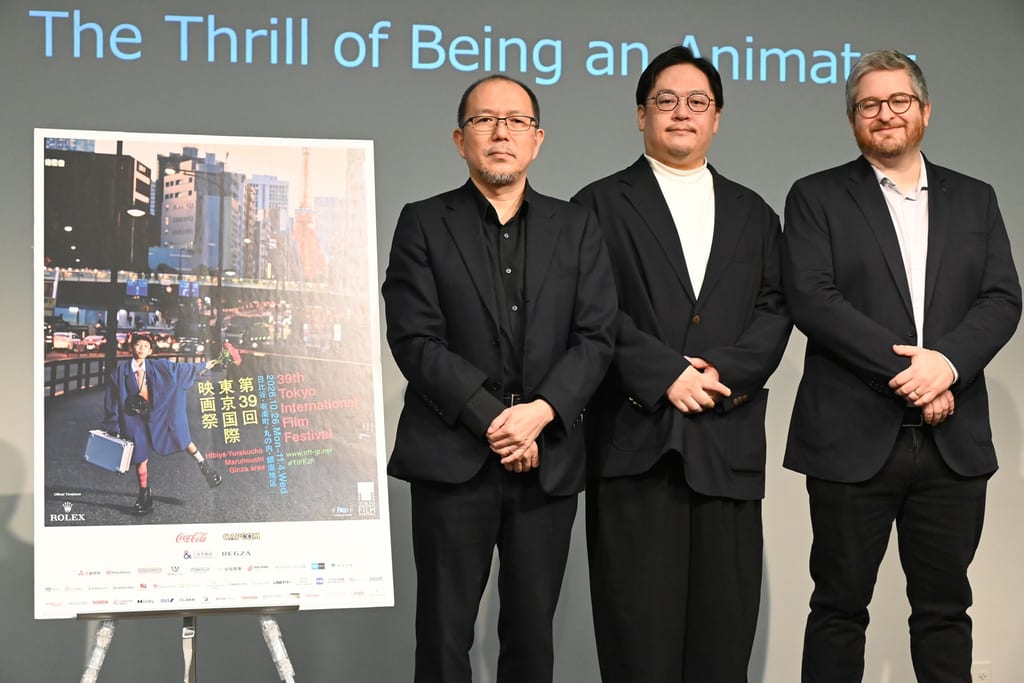
On November 3, the 39th Tokyo International Film Festival hosted a symposium titled “The Joys of Being an Animator” (アニメーターの醍醐味) as part of its animation program. Taking the stage were director Nishigori Atsushi — whose film GROTESQQQUE opens on November 6 — and French documentary filmmaker Alexandre Poncet, director of Walking with Animators, a film that goes behind the scenes at animation studios around the world. Animation programming advisor Fujitsu Ryota moderated. Director Natsume Shingo, who had been scheduled to appear, was absent due to illness.
“I Got Lucky” — Nishigori’s Early Career
Best known for his character designs on Tengen Toppa Gurren Lagann, and later as director of DARLING in the FranXX and chief animation director of Shin Evangelion Theatrical Version, Nishigori traced his path into the industry back to a single film. Seeing Neon Genesis Evangelion: The End of Evangelion moved him to leave for Tokyo, where he enrolled at the Toei Animation Academy. Just three months in, he spotted a job listing from Gainax and applied in secret — against his teacher’s advice.
“My teacher said I’d never get in, but I applied anyway and somehow made it through,” he recalled. “I wasn’t especially skilled at drawing or knowledgeable about anime. But my mentor Tsurumaki apparently felt there was a rough, untrained quality to my work — a ‘wild grass’ feel — and thought, ‘maybe someone like this could work here.'”
Though he had dreamed of becoming a manga artist as a child, Nishigori said the appeal of animation lies in its breadth. “It’s not just drawing movement — there’s a cinematographer’s eye involved, and the range of how different people interpret a performance is enormous.” He also credited his early colleagues with shaping him, noting that working alongside Imaishi Hiroyuki and Sushio on Mahoromatic, and being mentored by Hiramatsu Sadashi on Abenobashi Mahou Shoutengai, was “really good fortune.”
Alexandre Poncet: Animators Are Observers
Poncet, whose previous documentaries covered stop-motion legends Phil Tippett and Ray Harryhausen, said those projects deepened his understanding of animation and introduced him to many animators — ultimately inspiring Walking with Animators, which features interviews with over 70 creators working in hand-drawn, stop-motion, cut-paper, and 3DCG animation.
Nishigori, who had seen the documentary, said it “depicted that initial impulse — a primal passion for animation — and reminded me of an animator’s spirit I had almost forgotten while working as a director.”
Poncet identified one trait shared by all the animators he met: observation is their work. “They observe the world, pick something from it, and draw it. Everything is intentional — the decision of what to draw is itself the point,” he said, contrasting this with live-action filmmaking, where a camera simply records what exists.
Nishigori agreed, adding: “Feedback from observation is fundamental to what an animator does. Today you can shoot your own reference video or search for anything online, but how you choose to use that material is what matters. When drawing someone walking, what kind of person do you want to show? What are you expressing? A good animator can make that choice — and must — without wasting effort or drawing undue attention, while still serving the director’s intent.”
Culture Is Essential
Poncet spoke passionately about what he hopes Walking with Animators conveys: “Animators spend long, lonely hours at their desks — sometimes weeks of work for just a few seconds of footage. Most people never think about that hidden effort. In an age when a single click can generate video, it’s more important than ever to be aware of it.”
He also drew on the experience of the pandemic: “When lockdowns happened, there was a divide between ‘essential workers’ and ‘non-essential workers.’ But what did people do at home during lockdown? They watched films. They watched anime. Artists are often labeled non-essential — but what I want to say with this film is that culture is essential.”
“Five Inoue Toshiyukis and You Can Make Anything”
Asked bluntly what makes a great animator, Nishigori drew laughter from the audience with his answer: “In Japan, there’s already a clear answer — if you had five Inoue Toshiyukis, you could make any project.” He then added more seriously: “Someone who reliably delivers a large volume of solid work is invaluable. Someone who contributes even just a handful of exceptional cuts is a treasure to the industry. But what I personally love is an animator whose individuality comes through in the drawing — whose own way of thinking is visible on screen.”
During the audience Q&A, Nishigori was asked about his motivation to keep working in the industry. “I’m in my forties now, and the digital-native generation is incredibly talented — I do sometimes wonder if I can keep up,” he admitted. “But making GROTESQQQUE gave me a kind of resolve: as long as I’m given the opportunity, I’ll do what I love. And seeing people my own age working hard is a real motivator. Not wanting to lose, wanting to look good — that drives me.”
Poncet responded by noting that artists who truly love their work never really retire — pointing to Miyazaki Hayao, who famously announced his retirement after Princess Mononoke yet has continued making films ever since. Even audience members who didn’t speak Japanese caught the reference and laughed. “Everyone talks about new generations, new technology,” Poncet concluded, “but I think if you love what you do, you just keep doing it.”
 (แชร์แล้วไปกดรับที่หน้าภารกิจ · วันละ 1 lần)
