
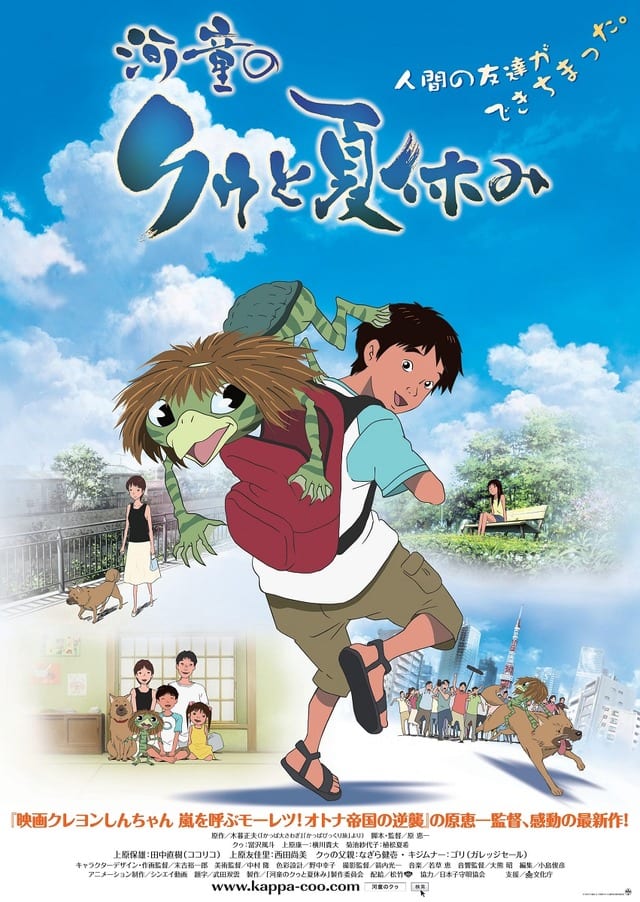
If one anime is inseparably linked to summer vacation, it is Kappa no Kuu to Natsuyasumi (河童のクゥと夏休み). Broadcast every summer on Animax, the film left a deep impression during childhood — the child actor’s tender voice as Kuu, the kappa swimming in a crystal-clear stream, crowds chasing after him through the streets, Kuu climbing Tokyo Tower. These images stayed vivid long after the details of the plot had faded.
What a Child Couldn’t See: The Selfishness of Humans
Returning to the film as an adult, however, reveals something far more layered. From the very first scene — in which Kuu’s father is cut down by a self-serving samurai — to the relentless media mob that hounds Kuu throughout the story, the film pulls no punches in depicting the darker side of human nature.
Even the protagonist Koichi is not without fault. While he shelters Kuu and is ostracised by his friends as a result, he also turns a blind eye to — and at times participates in — the bullying of his classmate Kikuchi. This is far from a simple, pastoral summer story.
What is striking is how little of this registered in childhood memory. The film was recalled simply as a boy meeting a kappa, sharing happy days together, and then parting ways. Even the fact that the film runs well over two hours came as a surprise upon revisiting it.
Kuu Through a Child’s Eyes: A Strange Little Housemate, Not Unlike Keroro
Looking back, it seems likely that a child steeped in Keroro Gunso (ケロロ軍曹) would have understood Kuu through that same lens — a peculiar, small creature who comes to live with a boy, bringing excitement to ordinary days. What made an impression even then, though, was how different Kuu was from Keroro: younger, lonelier, and visibly suffering. The eventual farewell hurt in a way that was hard to articulate at the time.
The sequence in which Koichi and Kuu cycle together through Tono (遠野) — the rural town of kappa legend, where nature and human life seem to breathe as one — also left a lasting mark. For many, the vivid image of a “rural Japanese summer” was shaped in no small part by this film.
A Film That Expands a Child’s World
Viewed again with adult eyes, Kappa no Kuu to Natsuyasumi stands as a work that captures the brightness of one summer shared with an unlikely friend, attends carefully to the emotional nuances of childhood, weaves in the selfishness and cruelty of which humans are capable, and yet never gives up on kindness.
Today’s children are building their own summer memories with films like Chiikawa: Ningyo no Shima no Himitsu (映画ちいかわ 人魚の島のひみつ), and the reactions of young audiences are already drawing attention. When those children grow up and look back, they too will likely discover layers they never noticed the first time — and that, perhaps, is what makes a great anime endure.
 (แชร์แล้วไปกดรับที่หน้าภารกิจ · วันละ 1 次)
