
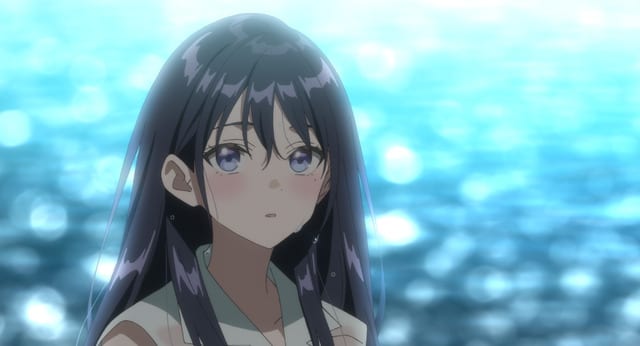
Anime film Doko yori mo Tooi Basho ni Iru Kimi e (To You, Who Are Farther Away Than Anywhere) is set to open nationwide in Japan on October 9, 2026. The story follows Tsukigase Kazuki, a boy who transfers to a remote island high school under mysterious circumstances, and Akika Nanao, a girl he meets there. Set against the island’s breathtaking natural scenery, the film weaves together a vivid coming-of-age story and a bittersweet fantasy that transcends time.
Ahead of the release, we sat down with director Wada Junichi and character designer and chief animation director Hechima to hear the behind-the-scenes story of the film — from adapting the source novel and scouting the real-life island model, to designing the lead characters and the moment the voices of Ishibashi Hiaki and Nagase Anna brought everything to life.
Profiles
- Wada Junichi — Director and storyboard artist. Previous works include directing Shuumatsu Nani Shitemasu ka? Isogashii desu ka? Sukutte Moratte Ii desu ka?, directing and series composition for Sakugan, and directing HIGH CARD.
- Hechima — Animator. Began animation work while still in university and joined Studio Colorido in 2016 as an animation director. Also handles character illustration for light novels, social games, and VTubers. Recent credits include character design (co-original concept) for Gakuen Idol Master and character design/chief animation director for Chou Kaguya-hime!.
Building the World from Oki Island: “You Could Believe the Story Really Happened Here”
Wada explained that one of the most important elements of the film was the island itself as a setting. Before production began, he took Hechima and key staff from the art and sound departments on a location scout to the real island that served as the model — the Oki Islands.
“I wanted both the backgrounds and the characters to carry a sense of ‘rural life’ and ‘island life,'” Wada said. “But because Hechima has such a strong personal style, I didn’t give overly specific instructions.”
Hechima, whose role was focused on characters rather than background art, said the trip was still invaluable. “There’s an atmosphere you can only feel by actually being there. I think sharing that with the whole team was really important.”
What struck Wada most about Oki was not just the beautiful sea and greenery, but the sense that real people lived there — a coexistence of ordinary rural life and an almost sacred, overwhelming presence of nature. “Standing there in person, you could genuinely believe that the events in the novel might actually happen in a place like this,” he said.
Adapting the Novel: Silence Over Narration
On the challenge of adapting the source novel into animation, Wada said his general approach doesn’t change much whether the source is a novel, manga, or game. What he noticed immediately upon reading the original, however, was that it was “a story told entirely from Kazuki’s point of view,” with a great deal of internal monologue that simply cannot be translated directly into visuals.
“At the script stage I considered adding more narration, but I felt that would break the spell,” he said. “So instead I deliberately created moments of silence, or let the music play on without any dialogue. If you’re making a film, it’s better to leave room for the audience to think rather than explaining everything in words. I was more conscious of that than I usually am when making TV anime.”
Hechima said that from the moment she read the novel, the characters’ appearances came to her quite naturally. “I didn’t have to agonize over them — it was more like the designs just surfaced on their own. Each character already had a distinct personality in the source material, even without any particularly distinctive speech patterns.”
Designing Kazuki and Nanao
For the two leads, Hechima said Kazuki’s design was guided by the fact that he is called “the prince” in the story — she wanted a look that would make that nickname feel natural. The result was a slightly androgynous, handsome boy with a hint of shadow about him.
For Nanao, the key concept was “cat-like.” After several iterations, the final design settled on a girl with the unaffected simplicity of someone born and raised on an island, a straightforward personality, and a classic heroine quality. “Above all, I needed the design to make it convincing that Kazuki would fall for her. That was the most important thing I kept in mind,” Hechima said.
The One Character They Debated: Mishima Tamaki
Wada noted that for most characters, his mental image and Hechima’s designs were very close. The exception was Mishima Tamaki, Kazuki’s classmate, where the two had to go back and forth.
“Hechima was drawing from her impression of the novel and script, while I had a specific directorial vision for the character, so we had to work through that,” Wada said.
Hechima explained that she had initially wanted Tamaki to look strikingly different from Nanao, but Wada asked her to emphasize the character’s capable, dependable quality more strongly. “I had drawn her with drooping eyes at first, but eventually we both felt that wasn’t right for her (laughs). Then it was a matter of finding a different way to differentiate her from Nanao.”
Wada praised Hechima’s range, noting that her “cool” characters all look distinctly cool in different ways, and her “cute” characters are each cute in their own way — there’s no sense of everyone converging on the same face. “She had so many ideas I never would have thought of. I was genuinely grateful.”
“When I Heard Their Voices, I Knew Everything Would Be Fine”
The interview also touched on the impact of the voice cast. When Ishibashi Hiaki (as Kazuki) and Nagase Anna (as Nanao) recorded their lines, both the director and the character designer felt the characters had finally become fully real. The phrase “I felt like everything would be okay” captures the team’s reaction upon hearing the cast for the first time — an immediate sense of reassurance that the characters were in the right hands.
Doko yori mo Tooi Basho ni Iru Kimi e opens across Japan on October 9, 2026.
 (แชร์แล้วไปกดรับที่หน้าภารกิจ · วันละ 1 times)
