
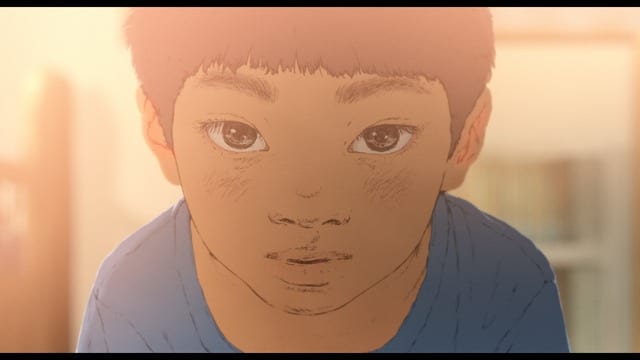
The feature-length animated film We are Aliens (我々は宇宙人), which opened in Japan on September 25, has been building steady word-of-mouth momentum. By November 1 — its 38th day in cinemas — the film had grossed a cumulative ¥422,337,400 and drawn 262,855 admissions. Its theatrical footprint has also grown, expanding from an initial 72 screens to a cumulative 110.
International Festival Recognition
The film marks the feature debut of director Kadowaki Kohei. Before its domestic release, it screened in the Directors’ Fortnight sidebar at the Cannes International Film Festival, and has since earned strong receptions at the Annecy International Animation Film Festival, the Ottawa International Animation Film Festival, and the Sitges–Catalonia International Film Festival.
Two Boys and an Irreversible Moment
The story is set in a rural Japanese town during the Heisei era. A shy, self-conscious boy named Tsubasa meets Gyotaro — a popular, seemingly “special” classmate — in the spring of third grade, and the two become close friends. Their bond is built on private games, aimless conversations, and walks home at dusk.
But one day Gyotaro begins to drift to the margins of the class, surrounded by rumours and sideways glances. Tsubasa wants to stand up for his friend yet fears becoming the next target himself. Caught between loyalty and self-preservation, he does nothing — and an irreversible event follows, casting a shadow over both boys’ lives across the next thirty years.
“Aliens” as a Symbol of Social Exclusion
One of the film’s most striking qualities is that no single character acts with clear malice. Instead, it is the accumulation of offhand remarks, rumours, averted eyes, and the gradual drift of the group that pushes one boy outside the circle. The word “alien” — used to label someone as fundamentally different, someone who doesn’t quite belong — captures this dynamic precisely.
Tsubasa’s inaction is not easily condemned. For a child, the prospect of stepping outside the group’s unspoken rules is a very real and immediate fear. Viewed through adult eyes, the question “why didn’t he help?” feels obvious; lived from inside that classroom, the answer is far more complicated.
Impressionist Visuals That Make Nostalgia Feel Personal
Director Kadowaki has spoken about how the film grew from a desire to preserve childhood memories through animation. While only around 20–30% of the content draws directly from his own experience, details such as a well-worn school bag or the worn corner of a classroom desk carry an uncanny power to trigger the viewer’s own recollections.
Nearly every shot was developed with live-action reference footage to capture the irregular, unpredictable movements of children. Kadowaki oversaw art direction, colour, animation, and editing himself to maintain a unified visual tone throughout. He has also noted a childhood admiration for Impressionist painting and 17th-century realism — an influence that is palpable in the film’s atmospheric, light-suffused imagery.
Because the Heisei-era countryside depicted in the film is not anchored to any specific real location, viewers can project their own classrooms, their own routes home, and their own former friends onto the screen.
Nostalgia With Shadows
We are Aliens offers the familiar warmth of childhood scenes, but that warmth is not uncomplicated. It also holds the things we once overlooked, the moments we went along with the crowd without questioning, and the events that look entirely different in retrospect. The film does not let its audience settle into comfortable nostalgia; it asks them to sit with old pain and unspoken regret.
That quality — the sense that this is somehow your own story — likely explains why the film’s theatrical run has continued to expand a month after opening. Audiences leave with something to say, and those conversations carry the film to the next viewer.
Film Details
- Title: 我々は宇宙人 / We are Aliens
- Release date: September 25 (Japan)
- Distribution: TOHO NEXT · NOTHING NEW
- Planning / Director / Screenplay: Kadowaki Kohei
- Cast (voices): Bando Ryuta, Okayama Amane, Yamazaki Sou (Sakurazaka46), Matsui Kemuri, Makiki Yuto, Nakagomi Yuku, Suzuki Saki, Suenaga Haru
- Music: Yaffle
- Theme song: adieu — “Sasakure” (music & lyrics: Yaffle / Sony Music Labels)
- Production: NOTHING NEW / MIYU PRODUCTIONS
 (แชร์แล้วไปกดรับที่หน้าภารกิจ · วันละ 1 times)
