
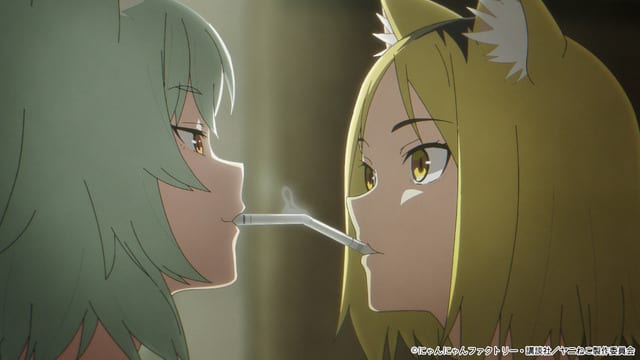
Yani Neko (ヤニねこ), an anime adaptation of the manga by Nyannyan Factory, began airing on TOKYO MX, BS11, and other channels on July 2, 2026. The series is produced by Bibury Animation Studios, the outfit behind acclaimed titles such as The Quintessential Quintuplets ∬ and Witch Watch.
Gorgeous Animation, Utterly Squalid Content
The show’s defining tension is the extreme gap between its exceptionally high production quality and the rock-bottom daily life it depicts. Every detail — the texture of protagonist Yani Neko’s fur, the wrinkles in a worn-out T-shirt, the irregular drift of cigarette smoke — is rendered with striking realism. Yet what that artistry is lavished upon is the thoroughly self-destructive lifestyle of a beastman who can’t seem to catch a break.
From episode one, viewers are treated to severe nicotine withdrawal during a part-time shift, a cigarette butt retrieved from a pile of street waste and smoked anyway, and a filthy, garbage-strewn apartment — all played for dark comedy. The result is that the beautiful visuals only make the grim reality feel more visceral, prompting strong reactions from audiences worldwide.
An OP Packed with Film Homages
Separate from the show itself, the opening sequence immediately became a talking point in its own right. Crafted with the same technical precision as the main animation, it is loaded with references to classic films. Viewers have been racing to identify each source, with scenes apparently drawn from Fight Club, Outrage, Joker, Midsommar, Shiawase no Kiiroi Hankachi, and The King of Comedy, among others — earning widespread praise as a “godlike OP.”
Fans also noticed that the numbers 3301 and 3401 appearing in the OP correspond to menu item numbers for draft beer and glass wine at the family restaurant chain Saizeriya, a hidden detail that has further fueled the community’s enthusiasm for discovery.
New Characters Push the Chaos Further
Episode two introduced Yaku Neko, a junior beastman living next door to the protagonist. Despite an outwardly cute appearance, she habitually smokes a “suspicious cigarette” that is clearly not ordinary tobacco. Scenes of her teaching Yani Neko how to smoke — leaving him in a violent coughing fit — and pulling out a syringe at home push right up against the limits of broadcast television.
Also joining the cast is Hame Neko, a video streamer who bills herself as a “fluffy angel.” She has an involuntary physical reaction when stimulated in a particular area, and episode two wastes no time in depicting it. In a separate incident, a clerical error at the city office results in her being officially registered under the surname “Yurufuwa Anaru Tenshi.”
More Than Just a Gag Anime? A Hidden Social Theme
The series is set in a society where humans and beastmen coexist, but the power dynamics are conspicuously skewed. In workplace scenes, the laborers are uniformly beastmen while their supervisors and managers are human. The world-building also establishes that beastmen are not born with surnames and must apply to a government office to obtain one — a detail that carries clear implications of systemic inequality.
A growing number of viewers argue that beneath the crude comedy lies a pointed social commentary, and the discussion shows no sign of dying down.
A Show That Divides Opinion
Social media responses after broadcast split sharply into two camps. Critics called it “physiologically impossible to watch” and “too disgusting to get through,” while supporters praised the audacity of “delivering this level of degeneracy with this level of animation in the Reiwa era” and called it “unmissable as a cautionary moral tale in reverse.”
The series is available in a broadcast on-air version with mosaic censoring over the most extreme scenes, as well as an uncensored “Jaryuu Kaihou-ban” (Evil Dragon Liberation Edition) on streaming platforms. Whether Yani Neko becomes the defining storm of the summer anime season remains to be seen, but fan attention is unlikely to waver anytime soon.
 (แชร์แล้วไปกดรับที่หน้าภารกิจ · วันละ 1 回)
