
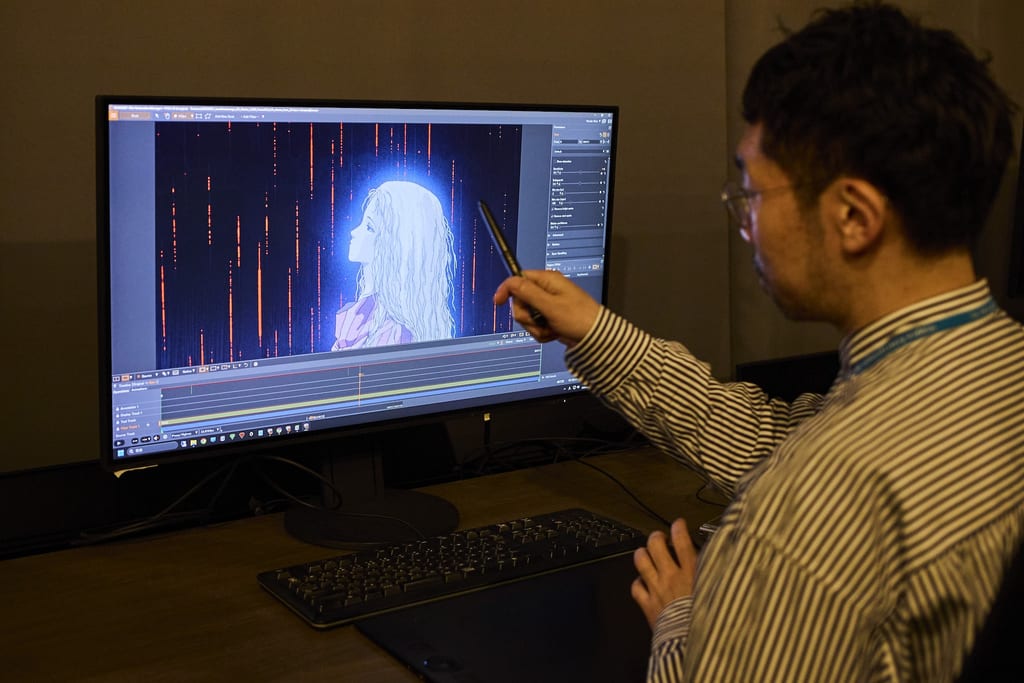
News of remastered screenings and Blu-ray releases of classic anime has become increasingly common in recent years. From beloved masterworks to niche OVAs, most of these titles are hand-drawn cel animations produced more than two decades ago. With some works created entirely on analog media — and original cels or audio sources long since lost — how exactly are they being restored to such stunning quality? Comic Natalie went inside IMAGICA Entertainment Media Services (Imagica EMS) to find out.
The company has handled remasters for titles including Angel’s Egg, Legend of the Galactic Heroes, and the theatrical version of Space Battleship Yamato. Natalie spoke with Ryohei Mito, head of the Media Sales Group and Archive Coordinator, and Kensuke Nakamura, Digital Restoration Supervisor, to break down the entire process.
What Is Remastering?
In simple terms, remastering is the process of restoring audio and video from past productions so they can be played back on modern media. By digitizing films that have deteriorated or become difficult to screen due to a dwindling number of projectors, studios can give new audiences access to works they might never otherwise see.
Imagica EMS has been in the digital restoration business for roughly 25 years, having worked on everything from Meiji-era films to Showa-period productions. The company views anime as “relatively recent material” by comparison — but that doesn’t make the remastering process any less demanding.
The Remastering Workflow
For film-based anime, the remastering process follows these key stages:
- Planning & Source Selection – Consult with the rights holder on the desired outcome and select appropriate source materials.
- Repair & Cleaning – Restore damaged film or tape and remove dirt and contaminants.
- Scanning & Digitizing – Convert the repaired materials into digital data.
- Restoration – Remove image instability, dust artifacts, and audio noise.
- Grading – Adjust color, brightness, and contrast.
- Sync & Assembly – Align audio and video, and join separate reels into a single continuous piece.
- Mastering – Generate deliverable files for theatrical, broadcast, and home video use.
Planning: Setting the Direction
Before any physical work begins, the team must establish a restoration policy — the job of Archive Coordinator Mito. The approach varies widely by title. Some projects aim to faithfully recreate the theatrical experience of the original release; others seek to correct errors that couldn’t be fixed at the time, or even give the footage a smoother look reminiscent of modern digital animation.
“The most common fix is painting errors,” Mito explained. “A color might be missing from part of a costume — something that couldn’t be corrected back then. Some fans say that’s part of the memory, while the director’s side may want it fixed because it was never intentional. We discuss all of that during planning.” Beyond corrections, the process can also expand creative expression — making colors more vivid, or converting a mono soundtrack into surround sound.
“During planning, I always ask the client and supervising director where they want the selling points of the film to be,” Mito said. Those priorities ripple through every stage of production, from added value and release strategy to marketing. Balancing ambition against time and budget constraints is one of the most critical parts of his role.
Source Selection: Finding the Right Materials
Once the plan is set, the team selects source materials. For cel anime, the primary source is almost always the original camera negative — the film negative created by photographing cels against backgrounds, representing the true original of the finished footage. While many people associate anime source material with the physical cels, those are considered intermediate materials; they are often discarded or passed on to collectors. Even if cels and backgrounds survive intact, re-photographing them would produce a different image — effectively creating a new work rather than restoring the original. This is why remastering remains possible even when cels are lost.
When the original negative is unavailable, the team turns to a release print — a copy of the negative made for theatrical or broadcast use. While inferior to the original, prints retain enough information to serve as a viable substitute.
Repair: Caring for the World’s Only Original
With materials in hand, Imagica EMS begins physical repair and cleaning at its Osaka studio. Even well-preserved negatives suffer from age — sprocket holes along the edges can degrade from repeated passes through printing machines, and some century-old live-action negatives crumble at the slightest touch. “There are situations where this is the last chance for digitization,” Mito noted.
Technicians repair damaged sections and splices using specialized tape, and clean film contaminated with dirt or oil both mechanically and by hand. Imagica EMS uses a wet cleaning process with a proprietary solvent that not only removes grime but also reduces the visibility of scratches that standard cleaning cannot eliminate.
After cleaning, the film is scanned immediately at the Osaka studio. Because film has no inherent resolution ceiling — it can project onto enormous screens with remarkable detail — high-resolution scanning enables 4K digitization and beyond. This is actually an advantage over natively digital productions, which are capped at their original resolution. Scanning is done frame by frame, converting each image into a still. Since film runs at 24 frames per second, a 90-minute feature yields at least 129,600 individual frames. Scanned at 4K in uncompressed format, that amounts to roughly 7 terabytes of data — all of which is then sent to the Tokyo studio for restoration.
The two studios maintain a constant live video connection for real-time coordination. When the reporter was given a glimpse of the Osaka facility online, it looked less like a video studio and more like a research laboratory, lined with specialized tools, chemicals, and equipment.
Audio: A Hidden Challenge
Audio source materials are more varied than picture sources. In addition to optical audio recorded on film, the team may use professional magnetic tape, depending on the era and circumstances. Tape with flaking magnetic coating may require heat treatment before use, and audio materials are often stored with far less care than picture materials, leading to significant deterioration. In such cases, Mito noted, the team sometimes turns to broadcast tapes held by television stations. His expression made clear that tracking down usable audio sources is a challenge every bit as demanding as finding the picture materials.
These are the unsung professionals who ensure that classics like Angel’s Egg can be experienced in a beauty that even their original audiences never saw — a testament to the painstaking craft behind every remastered frame.
 (แชร์แล้วไปกดรับที่หน้าภารกิจ · วันละ 1 回)
