
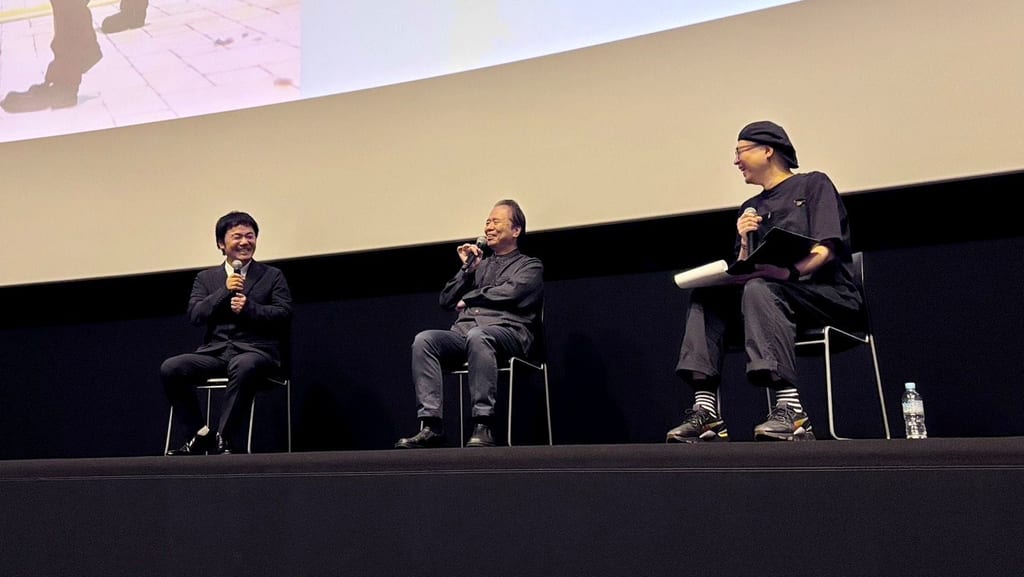
On November 8, the Marunouchi Piccadilly Dolby Cinema in Tokyo hosted the “A Silent Voice 10th Anniversary Dolby Cinema Staff Talk”, celebrating a decade since the release of the Kyoto Animation film based on Yoshitoki Oima‘s manga. Sound director Tsuruoka Yota and cinematography director Takao Kazuya took the stage to discuss the creation of the new Dolby Cinema version, which is currently screening alongside the film’s 10th-anniversary re-release.
Ten Years On
Asked about reaching the milestone, Tsuruoka said it felt like even more time had passed, but that he was glad to have the opportunity to celebrate. Takao was more effusive: “A Silent Voice is very much a coming-of-age film for us at Kyoto Animation. Looking back, the staff were mostly in their twenties and thirties, clashing and pushing each other to make something great. Watching it again, my heart genuinely ached. Everyone was fired up and truly wanted to make something special. I’m so happy it’s being screened again like this.”
How the Dolby Cinema Version Came to Be
Tsuruoka explained that the project began when he revisited the film in a cinema a few years ago and noticed that the piano music in the opening lacked rear surround sound — an unavoidable limitation of the original 5.1ch mix from 2016. “I felt that A Silent Voice should endure as a masterpiece of anime cinema,” he said. “When I raised the issue, it grew into a full commercial project, and people around me pushed for Dolby Cinema rather than just 7.1ch. I hope it can be enjoyed all the way to the 15th and 20th anniversaries.”
Takao added that he was delighted the initiative came from Tsuruoka, and that the producer asked him to make the picture as beautiful as possible for the Dolby Cinema presentation — a challenge he took on wholeheartedly.
Rebuilding from Source Materials
On the audio side, Tsuruoka noted that the team was able to reconstruct everything from the original materials. Sound effects were handled by Kurahashi Hiromune and the music Atmos mix by Furukawa Kenichi, resulting in what he described as a “truly native Atmos film.” “We did everything that could be done,” he said.
Takao spoke to the visual improvements, praising the quality of the Dolby Cinema screen itself. “The screen noise that bothered me in standard screenings is completely gone. And the color reproduction is excellent — A Silent Voice was made with jade green (翡翠色) as its thematic color, so we worked hard to make that green come through beautifully.”
The Final Scene — A World That Finally Expands
The most striking revelation came when the pair discussed what had been improved most significantly. Tsuruoka admitted that even at the time of the original release, he felt the final scene hadn’t fully reached where he wanted it to go. “With Atmos, we were able to use a technique of ‘narrowing the world’ — something we couldn’t really do before — and it has an incredibly strong affinity with this film. The reason we couldn’t get there originally was precisely because we couldn’t narrow it. This time, the scene where the world truly expands at the very end has finally been realized the way it should be. That’s the biggest thing for me, directionally.”
Takao laughed and said he was envious, since Tsuruoka could rebuild from raw materials while he was limited to refining the finished footage. “Maybe by the 20th anniversary I can polish it even more,” he said. He also reflected on the re-photography process — compositing backgrounds and characters and adding filters and CG — noting that there were scenes where his vision differed from director Yamada Naoko‘s at the time. “Things born from that clash have their own value. And we gave everything we had back then.”
Standout Moments and Behind-the-Scenes Stories
Asked which scene made him think “the sound is incredible,” Takao pointed to the piano music and specifically the subtle mechanical noise of the keys being pressed, which is now audible in a way that perfectly suits the film. Tsuruoka, in turn, praised the visual depth: “The dynamic range expansion deepened everything. The art backgrounds especially came alive — the breadth and depth of the world that the art team originally envisioned can now truly be felt.”
For favorite scenes, Takao chose moments featuring protagonist Ishida Shoya, recalling how the animation team struggled to capture “the Shoya feeling” and even filmed a staff member whose mannerisms resembled the character as a reference. “The scene where he eats a fried egg, slightly tilted — it has such atmosphere. I love it.” Tsuruoka chose the “My Generation” sequence and the final scene, and drew laughs from the audience by adding, “And this time I found myself thinking, ‘Maria is really cute, isn’t she?'” He then turned serious: “Every department — art, music, performance — produced expressions that could only have existed at that exact moment in time. That’s why it became an evergreen work.”
 (แชร์แล้วไปกดรับที่หน้าภารกิจ · วันละ 1 回)
