
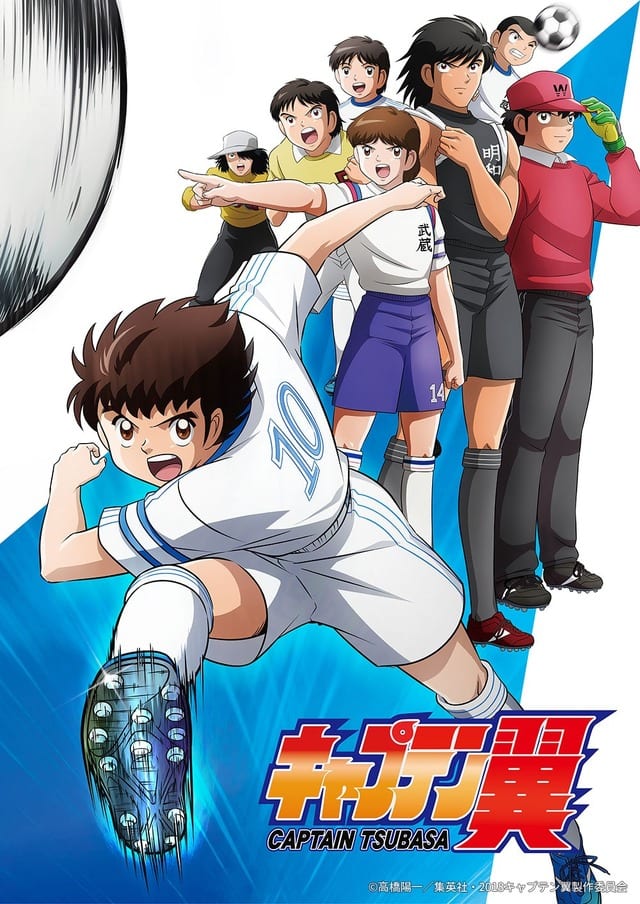
With the FIFA World Cup 2026 soon arriving in North and Central America, anime and football fans around the world are looking ahead with excitement. One of the best ways to prepare is to revisit a classic football anime, and no title fits better than Captain Tsubasa, the origin point for so much football anime that followed.
Tsubasa Ozora’s Dream and Its Border-Crossing Influence
Captain Tsubasa began as a manga in 1981 and left a deep mark on world football culture. The story of Tsubasa Ozora, a boy who believes that “the ball is my friend” and dreams of leading Japan to a World Cup title while becoming the world’s best footballer, continues to move readers across generations.
A key turning point for Tsubasa is meeting Roberto Hongo, a former Brazil national team player who inspires him to dream of playing in Brazil, the kingdom of football. Tsubasa’s growth through rivals, battles, and pure love of the sport forms the core that made the series beloved worldwide.
When the manga became a TV anime and aired around the world, its influence spread even further. World-class footballers including Kylian Mbappe, Zinedine Zidane, Neymar, and Andres Iniesta have openly said the series inspired them as children. It is rare for Japanese anime to ignite such passion in real-world football stars.
The Foundation of Football Anime
Today, football anime ranges from Inazuma Eleven and its superpowered special moves to Blue Lock and its brutal striker selection system, as well as more realistic youth football stories like Aoashi and DAYS. But before those works, Captain Tsubasa laid the foundation.
When the anime first aired in the 1980s, Japan had no professional football league, and reaching the World Cup was still a distant dream. Japan first appeared at the World Cup in France in 1998, and at that time the national team had no players active in overseas leagues. Today, Japan is filled with players competing in Europe’s top leagues, and at the 2022 World Cup in Qatar, the Samurai Blue shocked the world by beating both Germany and Spain.
In October 2025, Japan defeated Brazil for the first time in 13 meetings, a result that surely moved fans who grew up with Captain Tsubasa. The theme of “Japan challenging the world,” which the manga and anime presented for decades, is gradually becoming reality.
Famous Special Moves and Game-Like Fun
One of the enduring charms of Captain Tsubasa is its imaginative special moves, which are named with flair and look exciting in animation.
- Tsubasa Ozora’s Drive Shoot: a shot with fierce vertical spin that drops sharply before reaching the goal
- The Tachibana twins’ Skylab Hurricane: one twin acts as a launch platform so the other can fly upward for a header
- Genzo Wakabayashi: the goalkeeper known as SGGK, Super Great Goal Keeper, a phrase fans still remember
The way each side’s signature techniques clash like an RPG battle gives the series an identity no other football work can quite match.
Historic Matches and Rivals on the Road to the World
The series contains many unforgettable matches. One of the most famous is the junior high final between Tsubasa’s Nankatsu and Kojiro Hyuga’s Toho Gakuen, a clash of two philosophies and two forms of pride that fans still discuss.
In the Junior Youth arc, Japan steps onto the world stage and faces host nation France in the semifinals. Japan plays with only 10 men after a red card but still defeats French ace Pierre in a penalty shootout, the first penalty shootout in the series.
Looking toward World Cup 2026 also brings attention to the Netherlands, one of Japan’s real-life group-stage opponents. In Captain Tsubasa, the Dutch representative is Brian Kluivoort, an Ajax star whose powerful shot injures SGGK Wakabayashi’s right hand. In the sequel Rising Sun, he also shows new techniques such as the Spiral Shoot and Spiral Jumping Volley.
In the manga, Japan defeats the Netherlands 1-0 in the Youth arc and 4-1 in Rising Sun. Fans will be hoping the real Samurai Blue can produce another exciting performance in 2026.
A Dream Becoming Real
Tsubasa Ozora’s unwavering goal, leading Japan to win the World Cup, feels closer to reality than ever, both in the manga and in the real world. Captain Tsubasa teaches that daring to dream, saying that dream out loud, and working toward it without stopping can eventually turn the impossible into something possible. Before World Cup 2026 begins, it may be the perfect time to revisit the series and feel how much the distance between Japan and the world has changed over the decades.
Source: aniani
 (แชร์แล้วไปกดรับที่หน้าภารกิจ · วันละ 1 次)
