
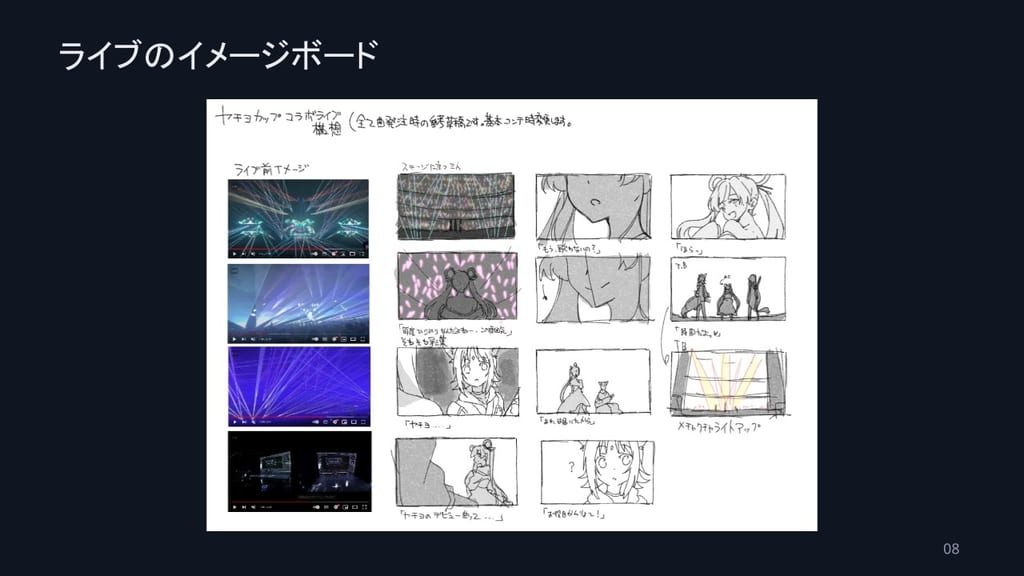
A special seminar titled “How the Collabo Live of Cho Kaguya-hime! Was Born” was held on November 2 at Toshima Civic Center in Tokyo, as part of the anime event TOKYO ANIME NEXT. The session pulled back the curtain on the making of the film’s acclaimed live-performance sequences.
The Speakers and the Project’s Origins
Two guests took the stage: Nakayama Naoya, who directed the in-film live scenes, and Momohara Kazuma, animation producer at Studio Colorido, for whom this was his first producing credit. Cho Kaguya-hime! originated as a streaming hit before receiving a theatrical run.
Momohara recalled a meeting with Nakayama in Kichijoji, Tokyo, roughly three to four years ago. The original plan called for live sequences covering as many as eight or nine songs — and Momohara asked Nakayama to handle all of them. In the end, Nakayama took charge of three scenes: a solo live for Yachiyo using the song “Hoshi Furu Umi,” and a collaboration live between Kaguya and Yachiyo featuring “Ex-Otogibanashi” and “World is Mine CPK! Remix.”
Joining the Team at the Pre-Production Stage
Nakayama came on board extremely early — right after the director, screenwriter, and concept-design team — at a point when many details had yet to be finalised. Even in-world items such as the “Smart Contact (Sumacon)” were still being developed alongside the script. To establish a shared vision, Nakayama brought his own early visuals to discussions with the director and producers, exploring questions like “who are these characters?” and “what kind of drama should the live scenes convey?”
Separately, conversations between director Yamashita Seigo and composer ryo (supercell) gave rise to the concept of the Kaguya–Yachiyo collaboration live as a “real-time broadcast performance.” That premise was handed to Nakayama, who developed it further — adding the detail that Kaguya’s room is crammed with luggage, and incorporating ideas such as the performers stumbling during the stream as an in-show mishap.
Previz in Blender: The Key to Precise Visual Communication
Once the broad shape of the live scenes was established, the workflow moved through choreography, motion capture, and then storyboarding. At that point, Nakayama built the stage model himself in the 3DCG software Blender, combined it with dancing character data, set up lighting, and assembled a locked-off “fixed-camera” preview of the entire stage presentation — a previz — which he then shared with the whole team.
“In normal anime production, outsourcing live-specific backgrounds and lighting to an external company often leads to mismatches in vision,” Nakayama explained. By sharing a near-final visual of the live content in advance, he was able to minimise miscommunication and stress on the production floor.
The Colour Team’s Praise: Lighting Data as a Game-Changer
The same approach proved invaluable during colour design. Because the characters and stage shift in colour from moment to moment as the lighting changes, Nakayama prepared dedicated colour-check reference materials that reproduced the lighting state of each cut inside Blender, and shared them with the colour team.
The colour team was reportedly full of praise for the documents; having precise lighting information dramatically raised the accuracy of their work. Momohara summed up his appreciation: “The phased sharing and rigorous schedule management were an enormous relief for everyone’s peace of mind,” crediting Nakayama’s approach as a key factor in the production’s smooth running.
Four Screens, One Philosophy
Towards the end of the seminar, four videos were displayed side by side on screen: the fixed-camera previz, the storyboard with camera moves, work-in-progress data, and the finished version. Gazing at them, Nakayama articulated his creative philosophy.
“It’s difficult to fully understand what another person is thinking. That’s precisely why I keep searching for every possible means of communication.”
He acknowledged that locking down a finished image so early might alter “the accidental chemical reactions that traditional production workflows sometimes produce,” but added: “Sharing directorial intent early on creates an environment where each staff member can express their creativity without hesitation — and that’s what made this production method so worthwhile for me.” The four screens on display made a compelling case that thorough visual communication was the foundation of the exceptional quality seen in Cho Kaguya-hime!‘s live sequences.
 (แชร์แล้วไปกดรับที่หน้าภารกิจ · วันละ 1 次)
