
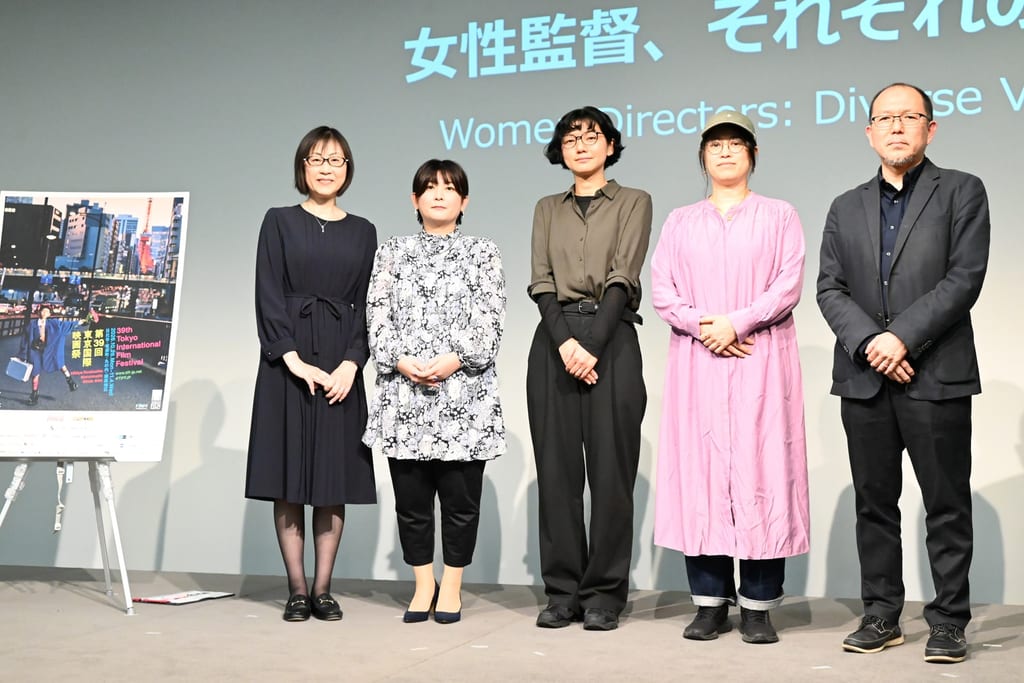
On November 1, as part of the Animation section of the 39th Tokyo International Film Festival, a special symposium titled “Female Directors, Each Their Own World” brought together three prominent anime directors: Chika Nagaoka, director of Detective Conan: The Fist of Blue Sapphire; Kotono Watanabe, director of The Colors of Wind (Kin no Kuni Mizu no Kuni); and Ai Yoshimura, director of the theatrical anime The Rose of Versailles. The session was moderated by Professor Akiko Sugawa of Yokohama National University’s graduate school.
Does Being a “Female Director” Affect Their Work?
Before the discussion began, animation programming adviser Ryota Fujitsu outlined the symposium’s intent, noting that when Japan’s animation industry started in the 1950s, women were largely confined to finishing and in-between animation roles. It was not until the late 1970s and 1980s that women began participating in creative decision-making, with a major shift occurring from the 2000s onward as digitization and improved working conditions opened the field further.
All three directors agreed that they rarely think about their gender in the course of their work. That said, Watanabe noted that clients sometimes specifically request a female director — particularly for titles adapted from shojo manga — and she takes it as a positive sign that they want a female perspective to bring out the story’s key emotional beats. Nagaoka recalled her surprise when the marketing for The Fist of Blue Sapphire highlighted her as the “first female director” of the franchise: “I was astonished that it became a selling point. We don’t think about it ourselves, but I suppose for audiences and marketing teams it still carries meaning.”
Ai Yoshimura and the Challenges of The Rose of Versailles
Yoshimura, who came up through Sunrise, said that robot anime never really featured in her life growing up, and that shojo manga has always felt more natural to her. The 2025 theatrical film The Rose of Versailles — a fully original new animation of the legendary manga — drew high praise from her fellow panelists. Watanabe said she felt “incredibly happy to see a manga I know come to life on screen,” while Nagaoka called the quality “extraordinarily high, with beautiful animation and the team’s passion visible in every frame.”
Nagaoka asked whether animators had been able to draw Oscar accurately, given how different the character’s design is from contemporary styles. Yoshimura was candid: “Honestly, very few could. Everyone tried their hardest, but something was always slightly off. In the end, character designer Mariko Oka had to step in and add that final touch.” As for future projects, Yoshimura said she wants to tackle horror — “People ask how you even scare someone in anime, and that’s exactly the challenge I want to take on” — and also hopes to expand her role beyond directing as she gets older.
Kotono Watanabe: Directing While Raising a Child During COVID-19
Watanabe, who is based at Madhouse, revealed that The Colors of Wind (released 2023) was made during the COVID-19 pandemic while she was also raising a young child. “After having a baby, I thought directing was probably off the table for me. But the company said they would support me, and my husband understood. My child also happened to be the kind of baby who could manage for about a year — it was partly a lucky coincidence. But whether it’s possible really does come down to whether the people around you are understanding.”
Nagaoka, who saw the film in theaters, was effusive in her praise: “You can feel the whole team working as one. The characters move so much and they’re incredibly cute. Please give me your autograph later!” Watanabe recalled her directorial choices with a laugh, noting that she personally storyboarded the scene where the dog Lukman falls into a hole to make him look as pitiable as possible, using his cuteness to carry the first half of the film. For the romantic nighttime scene in the middle of the story, she handed the reins to director Morio Asaka, whom she called “the master of heart-fluttering moments.” Watanabe also said her guiding principle is to make anime that doesn’t make audiences think “I could just read the manga” — she wants viewers to finish the film and then pick up the source material. For future work, she expressed interest in comedy, saying it allows for visual experimentation and gives younger staff room to contribute ideas.
Chika Nagaoka: Inheriting Conan from Everyone Who Came Before
Nagaoka has directed three Detective Conan theatrical films: The Fist of Blue Sapphire (2019), The Scarlet Bullet (2021), and The Million-Dollar Pentagram (2024). On working with such a long-running franchise, she said the most important thing is not to stray too far from the character that everyone before her has built. “Audiences have their own image of Edogawa Conan. I inherit the character they’ve all created, and then add just a little bit of my own Conan.”
When The Fist of Blue Sapphire came up, Yoshimura gushed: “There was a proper romance — they were holding hands! I was completely swooning.” Watanabe added that she loves the slow-burn tension of mutual crushes, and that watching The Million-Dollar Pentagram had her internally screaming for the characters to just confess already — while knowing full well a theatrical film probably wouldn’t let it happen. The three also celebrated the news that Heiji Hattori and Kazuha had finally become an official couple in the TV anime.
Reflecting on her own career, Nagaoka said she learned comedic timing from Gintama, the importance of layout and performance from Conan, and how to craft expressive faces and lovable characters from Uta no Prince-sama. “Working across different genres built a directing style I can call my own,” she said. Her approach to creating beloved characters involves keeping characters physically active, syncing dialogue tightly with facial expressions, and sometimes acting out scenes herself to check whether they work. “When you do that, the characters’ expressions become rich, a soul enters them, they connect with the voice actors’ performances, and they become endearing. I try to do that in every project.”
Having spent roughly twenty years in the industry since entering in her twenties, Nagaoka reflected on how her mindset has evolved: her twenties were about breaking into directing; her thirties were her most creatively passionate period; and now in her forties, she finds herself thinking about the younger directors working under her. “If they see my style, find something they like in it, and make it their own — that’s the best outcome I could hope for.”
 (แชร์แล้วไปกดรับที่หน้าภารกิจ · วันละ 1 次)
