
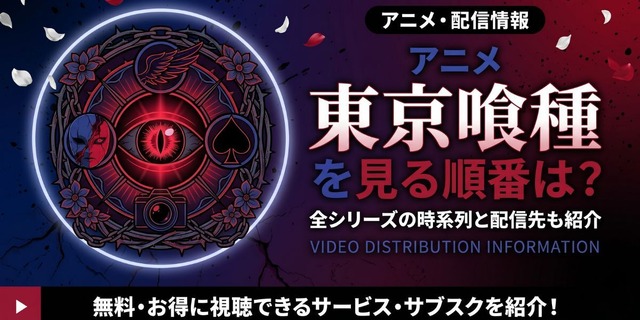
Tokyo Ghoul (Tokyo Ghoul) is a dark-fantasy anime adapted from the acclaimed manga by Ishida Sui, following the life of Kaneki Ken, an ordinary college student thrust into the conflict between the world of humans and the world of Ghouls — beings that feed on human flesh. The series spans a total of 6 entries including 2 OVAs, and this article walks you through the ideal watch order along with synopses and key details for each installment.
Recommended Watch Order: Follow Release Order
For those just starting the series, watching in release order is strongly recommended. Although both OVAs are set before the events of the main story, watching them first diminishes the emotional impact and attachment to the characters built in Season 1. Following the order below will let you fully appreciate each character’s development.
- 1. Tokyo Ghoul (Season 1) — Aired July–September 2014
- 2. Tokyo Ghoul √A (Season 2) — Aired January–March 2015
- 3. OVA: Tokyo Ghoul [JACK] — Released September 2015
- 4. OVA: Tokyo Ghoul [PINTO] — Released December 2015
- 5. Tokyo Ghoul:re (Season 3) — Aired April–June 2018
- 6. Tokyo Ghoul:re Final (Season 4) — Aired October–December 2018
If you prefer to watch in in-universe chronological order, the sequence would be JACK → PINTO → Season 1 → √A → :re → :re Final. However, first-time viewers may accidentally learn details about Arima Kisho and Tsukiyama Shu ahead of time, which can reduce the excitement of the main seasons.
1. Tokyo Ghoul Season 1 (2014)
- Broadcast period: July–September 2014
- Episodes: 12
- Director: Morita Shuhe
- Main cast: Hanae Natsuki, Amamiya Sora, Miyano Mamoru, Namikawa Daisuke
Kaneki Ken, an ordinary college student, is savagely attacked by a Ghoul named Rize and left gravely injured. After surviving, Ghoul organs are accidentally transplanted into his body, transforming him into a “half-ghoul” who must consume human flesh to survive. This marks the beginning of his descent into the underground world of Ghouls.
Highlights: The opening theme “unravel” by TK (Ling Tosite Sigure) has become the series’ signature song, while Hanae Natsuki’s voice performance powerfully conveys Kaneki’s emotional complexity. The conflict between Ghouls and the CCG (Commission of Counter Ghoul) is deliberately morally ambiguous, with no clear good or evil side.
2. Tokyo Ghoul √A Season 2 (2015)
- Broadcast period: January–March 2015
- Episodes: 12
- Director: Morita Shuhe
- Main cast: Hanae Natsuki, Amamiya Sora, Miyano Mamoru, Namikawa Daisuke
Season 2 follows an original anime storyline overseen by Ishida Sui himself, diverging from the source manga. Rather than following the manga’s path, Kaneki chooses to join the Ghoul organization Aogiri Tree. The season carries the tagline “tragedy, round two,” reflecting the collapse of the bonds built in Season 1.
Highlights: The opening theme “無能 (Munō)” by österreich perfectly captures this season’s dark atmosphere, and the story delves deeper into the inner workings of Aogiri Tree and characters such as Eto and Arima.
3. OVA: Tokyo Ghoul [JACK] (2015)
- Release date: September 2015
- Length: Approximately 30 minutes (1 episode)
- Director: Shimada Soichi
- Main cast: Namikawa Daisuke (Arima Kisho)
This OVA flashes back 12 years before the main story, recounting the fateful meeting between Fura Taishi, a high school student, and a young Arima Kisho before he became the renowned Ghoul investigator. Adapted from a one-shot manga by Ishida Sui.
Highlights: It is the only work that portrays Arima Kisho’s youth; watching it after the main seasons casts this character in a much deeper light. Despite running only 30 minutes, it stands complete on its own as a short story.
4. OVA: Tokyo Ghoul [PINTO] (2015)
- Release date: December 2015
- Length: Approximately 24 minutes (1 episode)
- Director: Matsuhayashi Yuito
- Main cast: Miyano Mamoru (Tsukiyama Shu)
This OVA dives into the high school life of Tsukiyama Shu, one of the franchise’s most beloved characters. Adapted from a short story by Ishida Sui titled “Photograph,” it follows Tsukiyama’s encounter with a young girl passionate about photography named Hori Chie, revealing a side of him completely at odds with his persona in the main series.
Highlights: This is a rare piece that showcases Tsukiyama’s unguarded feelings in his youth. Furthermore, Hori Chie reappears in :re Season 3, making watching PINTO beforehand significantly enrich those scenes.
5. Tokyo Ghoul:re Season 3 (2018)
- Broadcast period: April–June 2018
- Episodes: 12
- Director: Watanabe Yasuhiro
- Main cast: Hanae Natsuki, Ishikawa Kaito, Kugimiya Rie, Shimono Hiro
Adapted from the second manga arc, the story takes place two years after √A. Kaneki Ken, stripped of his memories, returns under the alias “Sasaki Haise,” a Ghoul investigator leading the Quinx Squad. The series begins anew from a radically different perspective.
Highlights: The intrigue lies in following Sasaki Haise, whose personality differs sharply from Kaneki’s, while viewers who have watched since Season 1 will catch the fragments of buried memory surfacing. The opening theme “asphyxia” by Cö shu Nie instantly conveys the characters’ tension the moment you hear it.
6. Tokyo Ghoul:re Final (2018)
- Broadcast period: October–December 2018
- Episodes: 12
- Director: Watanabe Yasuhiro
- Main cast: Hanae Natsuki, Sakamoto Maaya, Ishikawa Kaito, Kugimiya Rie
The concluding chapter of the entire series, adapted from the final portion of the manga. The story picks up directly from Season 3 and brings everything to a resolution of the war between Ghouls and humans. It is best watched immediately after Season 3 to maintain narrative tension.
Highlights: This season gathers every thread and mystery accumulated since Season 1 and drives them to a climax. The opening theme “katharsis” by TK from Ling Tosite Sigure — the same artist behind “unravel” in Season 1 — provides a perfect close to the series’ full circle.
Main Characters and Voice Cast
- Kaneki Ken / Sasaki Haise — Hanae Natsuki (Demon Slayer: Kamado Tanjiro; Your Lie in April: Arima Kosei)
- Kirishima Touka — Amamiya Sora (KonoSuba: Aqua; Rent-a-Girlfriend: Mizuhara Chizuru)
- Tsukiyama Shu — Miyano Mamoru (Death Note: Yagami Light; Gundam 00: Setsuna)
- Arima Kisho — Namikawa Daisuke (Haikyuu!!: Oikawa Toru; HxH: Hisoka)
- Urie Koki — Ishikawa Kaito (Haikyuu!!: Kageyama Tobio)
- Suzuya Juzo — Kugimiya Rie (Gintama: Kagura; Shakugan no Shana: Shana)
- Eto / Takatsuki Sen — Sakamoto Maaya (Tsubasa Chronicle: Sakura; FGO: Da Vinci)
- Naki — Shimono Hiro (Demon Slayer: Agatsuma Zenitsu)
Frequently Asked Questions
Is the series finished?
The anime concluded completely with Tokyo Ghoul:re Final in 2018. Ishida Sui’s source manga also wrapped in the same year; the anime covers the story through volume 16 of the manga.
Are the two OVAs required viewing?
They are not essential for following the main plot, but they significantly deepen the characterization of Arima and Tsukiyama. PINTO in particular is especially rewarding since its character reappears in :re.
How different is the anime from the manga?
Season 1 hews fairly closely to the manga, but Season 2 (√A) is an original anime storyline that diverges substantially from the source material. Seasons 3 and 4 compress a large volume of content into 12 episodes each, leading to certain scenes and details from the manga being cut.
When should I watch the live-action film?
The 2017 live-action film starring Kubota Masataka as Kaneki is a standalone work separate from the anime. It is recommended to watch it after completing at least the first anime season to understand the world, or after finishing the entire anime series if you want to compare the two adaptations.
Source: aniani
 (แชร์แล้วไปกดรับที่หน้าภารกิจ · วันละ 1 times)
