
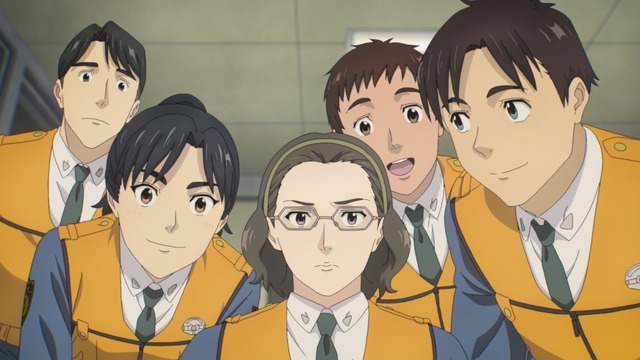
Nearly 40 years after the first OVA series in 1988, the legendary Patlabor franchise returns with Mobile Police Patlabor EZY, a completely new work telling an eight-episode story. The episodes are being screened in theaters across three parts, with “File 1” currently in theaters.
For the occasion, members of the original creator group HEADGEAR – director Yutaka Izubuchi, scriptwriter and series composition writer Kazunori Ito, and original character designer Masami Yuki – discussed the origins of the new-generation characters, the setting of the world, and the project’s future direction.
From “We Probably Can’t Do It” to a Sense of Mission
One of EZY’s defining features is that it introduces an all-new generation of characters in Special Vehicles Section 2, led by Towa Kuga. Izubuchi said he initially did not expect to have to build a world set nearly 30 years later, and Yuki admitted that everyone felt the same way.
“To me, Patlabor is a series that grew up alongside its fans, so having an entirely new generation of characters take over felt more natural than forcing the old cast to return,” Izubuchi said.
Ito admitted that early characters such as Noa and her teammates had an excellent balance, making it an enormous challenge to create characters who could surpass them. Yuki even said, “The bar is too high. We probably can’t do it.” Ito insisted they could – before later laughing and admitting it was just overconfidence.
Yuki participated as original character designer, but later had to step back because his manga Shinkurou, Hashiru! kept him too busy to attend all the script meetings. As a result, he watched the finished work as a viewer and said the result felt “fresh.”
According to Ito, the team’s main driving force was not excitement, but a “sense of mission” – the feeling that if they did not make it, no one else could.
How to Build New Characters That Veteran Fans Can Embrace
Ito’s method for creating the new cast was to “shift” the roles of older characters slightly. For example, main protagonist Towa carries some of the atmosphere of Ota from the previous series, while Yakumo takes on a role similar to Hiromi’s but is reworked as a more girlish female character.
Ito said he wished there had been more time to develop the characters, but the eight-episode structure left him feeling that the story had not fully unfolded. Izubuchi added that while this kind of “shifting” gives longtime fans a sense of familiarity and reassurance, hidden backstories were also prepared, such as hobbies not revealed in the story.
EZY’s World: When Labors Are Becoming Extinct
EZY continues from the timeline of the “NEW OVA” series. The staff noted that Mamoru Oshii’s live-action film exists in its own separate world and is not connected to the other works.
Izubuchi said he initially considered making the setting highly realistic, with the Babylon Project over and Special Vehicles Section 2 recovering the remaining Labors. In today’s world, piloted robots are already outdated, being replaced by AI-equipped autonomous machines, and the remaining Labors could be used in crimes.
When the idea was presented to the producer, however, the response was that it had “no dream” and made the world feel like it was ending. The team therefore set that strict realism aside and instead created a variety of episode-by-episode stories, almost like one-shot manga, in order to return to the spirit of the original series.
3DCG and New-Generation Mecha Action
EZY is Patlabor’s first full-length work produced entirely digitally. Izubuchi believes that Labors, as industrial machines, are well suited to 3DCG, and that current hand-drawn animation could no longer support the level of mecha action they wanted.
“3DCG lets us show the details we want and meet the quality viewers expect. It takes time, but the result is satisfying,” Izubuchi said. Yuki agreed, saying there were many scenes where he felt glad they chose 3DCG.
Source: aniani
 (แชร์แล้วไปกดรับที่หน้าภารกิจ · วันละ 1 times)
