
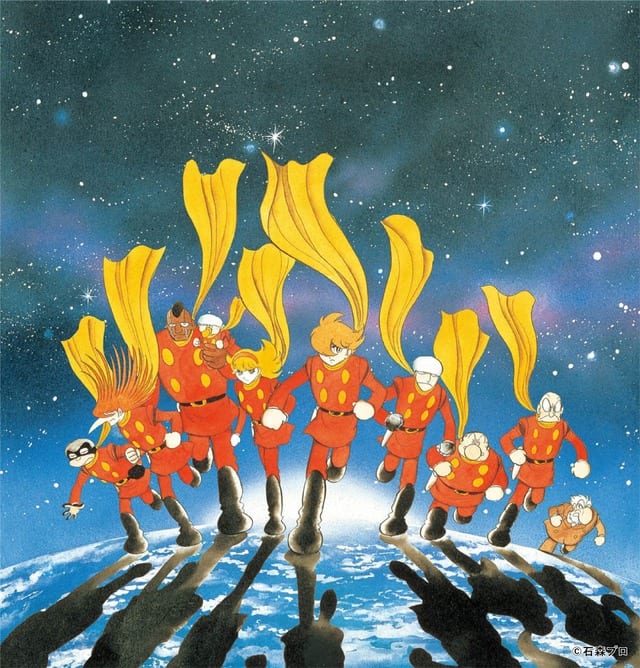
The new anime Cyborg 009 Nemesis begins streaming on Sunday, July 19, 2026, from 00:00 JST. The story centres on a nine-member cyborg team called “Nemesis,” who rise up to bring peace to the world in place of 009 and his original companions — effectively a second set of Cyborg 009s that fans are already buzzing about.
Based on the original manga by the late Ishinomori Shotaro, the series is generating early excitement thanks to its opening theme: 「誰がために」(Dare ga Tame ni), the beloved theme from the Cyborg 009 (1979) anime for which Ishinomori himself wrote the lyrics. The song has been re-recorded in a modern arrangement performed by Kyoko, whose husky, powerhouse vocals have already made waves in the preview footage.
A Manga Artist Who Wrote Nearly 100 Songs
While Ishinomori is celebrated as a legendary manga creator, far fewer people know that he also wrote lyrics for close to 100 songs. What sets his work apart is that each song functions almost as a self-contained narrative — listeners can immediately grasp who the hero is, what they are fighting, why they fight, and how they fight, all from the lyrics alone. It is storytelling compressed into verse, and it bears the unmistakable stamp of a master manga artist.
Precision Word Choice: The Manga Artist’s Touch
A prime example is the theme for Kamen Rider V3 (1973). The story follows Kazami Shiro, who loses his parents and sister before being reborn as the third Kamen Rider through surgery performed by Riders 1 and 2. Ishinomori captured V3’s signature transformation belt in a single phrase — 「力と技の風車が廻る」 (“the windmill of strength and skill turns”) — and conveyed the revenge narrative with just 「父よ母よ妹よ」 (“O father, O mother, O little sister”).
For Kamen Rider Amazon (1974), whose hero is a feral child raised in the Amazon rainforest, the song opens with a primal war cry — 「ア、マ、ゾーン!」 — and uses phrases like 「牙がひかるぞ」 (“fangs flash”) and 「爪がうなるぞ」 (“claws growl”) to evoke Amazon’s wild, biting, slashing fighting style, which was deliberately more savage than any previous Rider.
The theme for the original Kamen Rider (1971), 「レッツゴー!! ライダーキック」, takes an unusual approach for a hero show: it opens by emphasising just how evil the villainous organisation Shocker is. This makes sense once you remember that Kamen Rider was himself created by Shocker — a monster turned rebel — and that the organisation is the true axis around which the story revolves. Only the creator of that story could have written it that way.
Ishinomori’s playful side surfaces in the themes for Himitsu Sentai Gorenger (1975) and Kamen Rider Super-1 (1980). Both feature five-colour motifs as a core gimmick. The Gorenger theme 「進め!ゴレンジャー」 weaves each member’s colour into its lyrics — red sun, blue sky, yellow dust, pink cheeks, green wind — while the Super-1 theme does the same for the hero’s five-coloured “Five Hand” gloves.
“Dare ga Tame ni” — An Anime Song Written for Adults
In 1979, anime was still widely considered children’s entertainment, and it was standard practice for theme songs to include the show’s title in the lyrics. Contemporary shows like Mobile Suit Gundam, The☆Ultraman, and Zendaman all followed this convention. Yet 「誰がために」 contains no title at all — only the phrase “cyborg warrior” — and is filled with metaphorical language and imagery that would challenge younger listeners: 「9人の戦鬼」 (nine warrior demons), 「地獄の使者」 (messengers of hell), 「涙で走る血の大河」 (a river of blood flowing with tears).
The reason lies in the franchise’s history. Cyborg 009 first appeared in Weekly Shonen King in 1964, was adapted into a feature film in 1966, and received its first TV anime in 1968. The 1979 series was a remake arriving roughly a decade after the first anime — meaning fans who had followed the manga from the beginning had been waiting fifteen years. The intended audience included adults, and the tone of both the lyrics and the melody was crafted to resonate with those returning fans.
The 1979 series was directed by Takahashi Ryosuke, who would later create or co-create Fang of the Sun Dougram, Armored Trooper Votoms, Galian, and Blue Comet SPT Layzner — a filmography that speaks volumes about the series’ tone.
Now that beloved song is returning in a new arrangement for Cyborg 009 Nemesis, performed by Kyoko. A taste of it is already audible in the promotional video, and it promises to be every bit as stirring as the original.
Broadcast Information
Cyborg 009 Nemesis
Streaming begins: July 19, 2026, from 00:00 JST
Cast
- 009 / Shimamura Joe: Kaji Yuki
- 001 / Ivan Whisky: Minagawa Junko
- 002 / Jet Link: Miyano Mamoru
- 003 / Françoise Arnoul: Hayami Saori
- 004 / Albert Heinrich: Sugita Tomokazu
- 005 / Geronimo Jr.: Yasumoto Hiroki
- 006 / Chang Changku: Kanuka Mitsuaki
- 007 / Great Britain: Tone Kentaro
- 008 / Pyunma: Hayashi Isamu
- Dr. Gilmore: Yamaji Kazuhiro
- N009 / Graviton: Nakamura Yuichi
- N001 / Mew: Hidaka Rina
- N002 / Blizzard: Hosoya Yoshimasa
- N003 / Crack: Kamiya Hiroshi
- N004 / Opro: Inoue Kikuko
- N005 / Aspida: Inada Tetsuo
- N006 / Blitz: Wakayama Shion
- N007 / Morphin: Uchida Maaya
- N008 / Depth: Sakura Ayane
- Dr. Golvart: Nara Toru
- Ispano: Shimono Hiro
Staff
- Original Work: Ishinomori Shotaro
- Director: Ambo Hideki
- Series Composition: Tomioka Atsuhiro, Kyaratex
- Character Design: sanorin
- Opening Theme: 「誰がために」performed by Kyoko (Office Augusta)
- Ending Theme: 「クライマル」performed by Sukimaswitch (Office Augusta)
- Animation Production: Alecto
- Production: Ishimori Pro
Songs Referenced in This Article
- Cyborg 009 (1979) — 「誰がために」
- Cyborg 009 Nemesis (2026) — 「誰がために」covered by Kyoko
- Kamen Rider V3 (1973) — 「仮面ライダーV3のテーマ」
- Kamen Rider Amazon (1974) — 「アマゾンライダーここにあり」
- Kamen Rider (1971) — 「レッツゴー!! ライダーキック」
- Himitsu Sentai Gorenger (1975) — 「進め!ゴレンジャー」
- Kamen Rider Super-1 (1980) — 「仮面ライダースーパー1」
 (แชร์แล้วไปกดรับที่หน้าภารกิจ · วันละ 1 回)
